How much should a self-employed person set aside for tax in the UK?
A practical, no-nonsense starting point for reserving tax as a self-employed person in the UK — Income Tax, National Insurance, and the payments-on-account trap that catches people out in year two.
- A common planning figure is to set aside roughly 25 to 30% of your profit, not your invoices.
- From year two, payments on account can make your first big bill about 1.5 times what you expect.
- Move the tax share aside the moment you are paid, not at year end.
If you've gone self-employed recently, you've probably heard some version of "just put 20-25% aside for tax." It's a reasonable rule of thumb, but it glosses over two things that catch a lot of people out: your actual rate depends on how much you earn, and there's a second tax bill called "payments on account" that nobody warns you about until it lands.
Here's the more useful version.
The two things HMRC actually charges you
As a sole trader, you pay Income Tax and Class 4 National Insurance on your profit (what's left after business expenses, not your total invoiced amount). For most people starting out, a reasonable planning figure is around 25-30% of profit set aside — enough to cover basic-rate Income Tax plus National Insurance for most earners. If you're a higher earner, or your profit pushes into the higher tax bands, that share goes up. Since bands and rates change, HMRC's own tax calculator is worth checking against your actual numbers rather than relying on any fixed percentage indefinitely.
The bit that actually catches people out: payments on account
This is the one that causes real problems, and it's rarely mentioned early enough. From your second year of self-assessment, HMRC usually asks you to pay not just what you owe for the year just gone, but an advance chunk — typically half again — toward the year ahead. That means your first "proper" tax bill as a two-year-in self-employed person can be roughly 1.5x what you were expecting, because you're paying last year's bill and a head start on this year's at the same time.
If you've been reserving a steady percentage of income as you go, this is manageable — it's still your money, just claimed earlier than you might expect. If you haven't been setting anything aside, this is the bill that puts people in genuine difficulty.
The practical fix: treat tax like a bill that's already spent
The single most effective habit is treating your tax reserve as money that was never really yours to spend in the first place — moved aside the moment it arrives, not calculated at the end of the year when it's already gone. This is exactly the problem MoneyMap's off-the-top rules exist to solve for self-employed income specifically: a percentage is reserved automatically, every time you're paid, before you ever see the rest as spendable.
A rough worked example
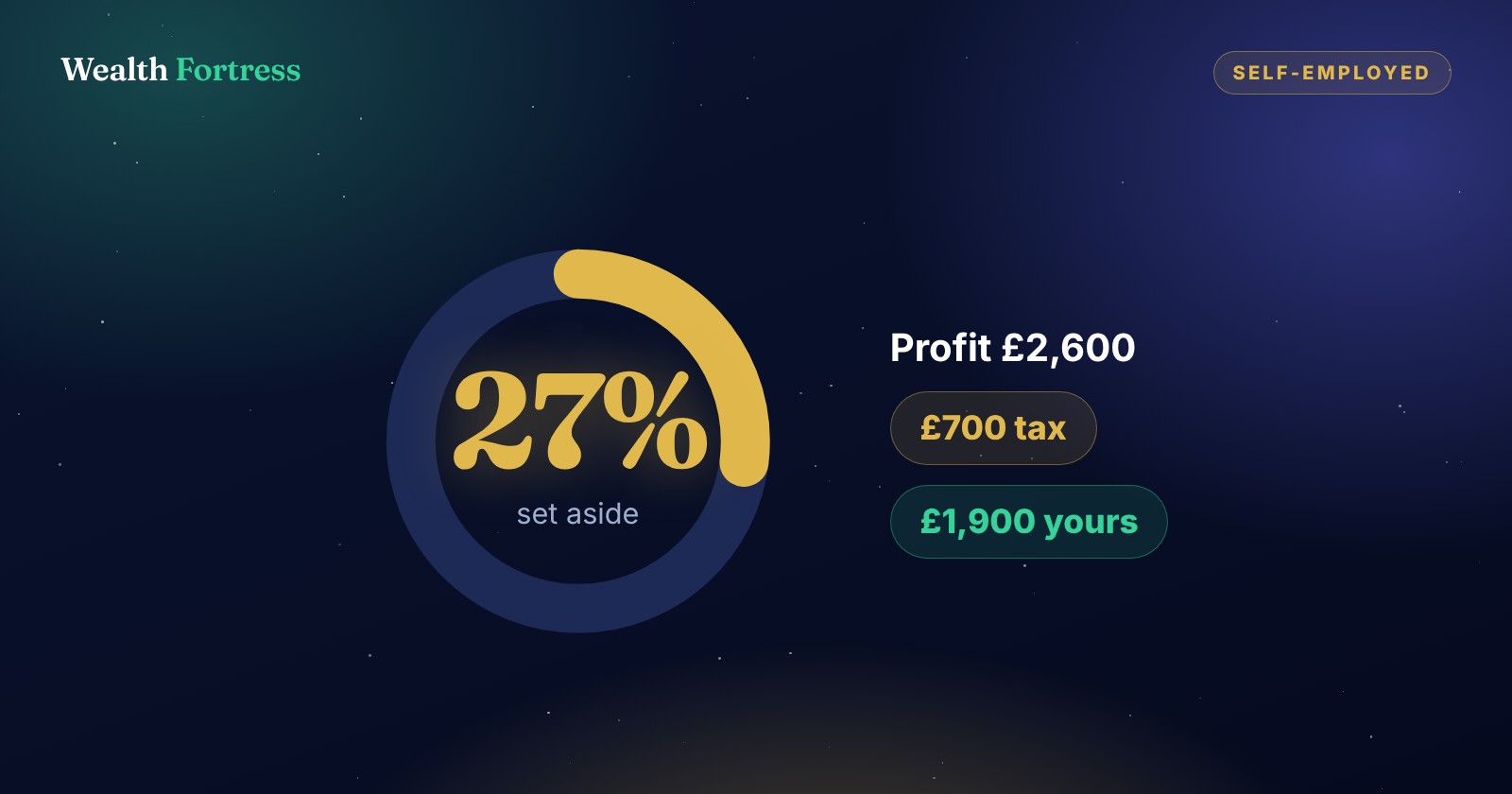
Say you invoice £3,000 in a month, with £400 of genuine business expenses. Your profit for that month is £2,600. Setting aside roughly 27% for tax and Class 4 NI means reserving about £700, leaving £1,900 as the money you actually have to live on and allocate elsewhere. That reserved £700 isn't lost — it's just not yours to spend yet.
Not sure where to start with the rest?
If tax is sorted but you're not sure how to split what's left — buffer, debt, investing, goals — our free Golden Percentages tool asks a handful of honest questions and builds a personalised starting split in about two minutes. No signup needed.
See every payment routed
Try MoneyMap with sample numbers. Nothing is saved and there is no signup.
Open the MoneyMap demo