We get paid on completely different days — how do you actually budget as a couple?
One of you gets paid monthly, the other in dribs and drabs across the month. Here's why that breaks most budgeting advice, and the one decision that fixes it.

- When paydays differ, whoever is paid first quietly ends up covering the bills.
- Decide once whose income covers the fixed household costs, whatever the order of payments.
- If incomes are uneven, a proportional split often feels fairer than 50/50.
If you and your partner get paid on the same day, budgeting as a couple is straightforward: the money lands, you split it, done. Most budgeting advice quietly assumes this. But plenty of real households don't work that way — one of you is on a monthly salary, the other is self-employed, on shift pay, or paid in irregular instalments that land whenever they land.
When that's your situation, a really common thing happens: whoever's money arrives first ends up covering the rent, the mortgage, the bills — not because you decided that, but just because it was there when the direct debit came out. The other person's money then feels "free" by comparison, even though nothing was actually agreed. A few months of this and one partner starts to feel like they're quietly carrying the household, while the other genuinely doesn't realise it, because on paper you're both contributing.
The fix isn't a better calendar, it's a decision made once
The instinct is to try to time things better — track whose payday is when, plan around it. That's fragile, because paydays shift, self-employed income is never quite predictable, and you end up renegotiating the same conversation every month.
The actual fix is simpler: decide, once, whose income is responsible for the fixed household costs — rent or mortgage, utilities, council tax, the lot — regardless of whose payment happens to land first in any given month. That decision doesn't change month to month. It's not about who earns more or who "should" pay more; it's just clarity about which money has a job to do before anything else touches it.
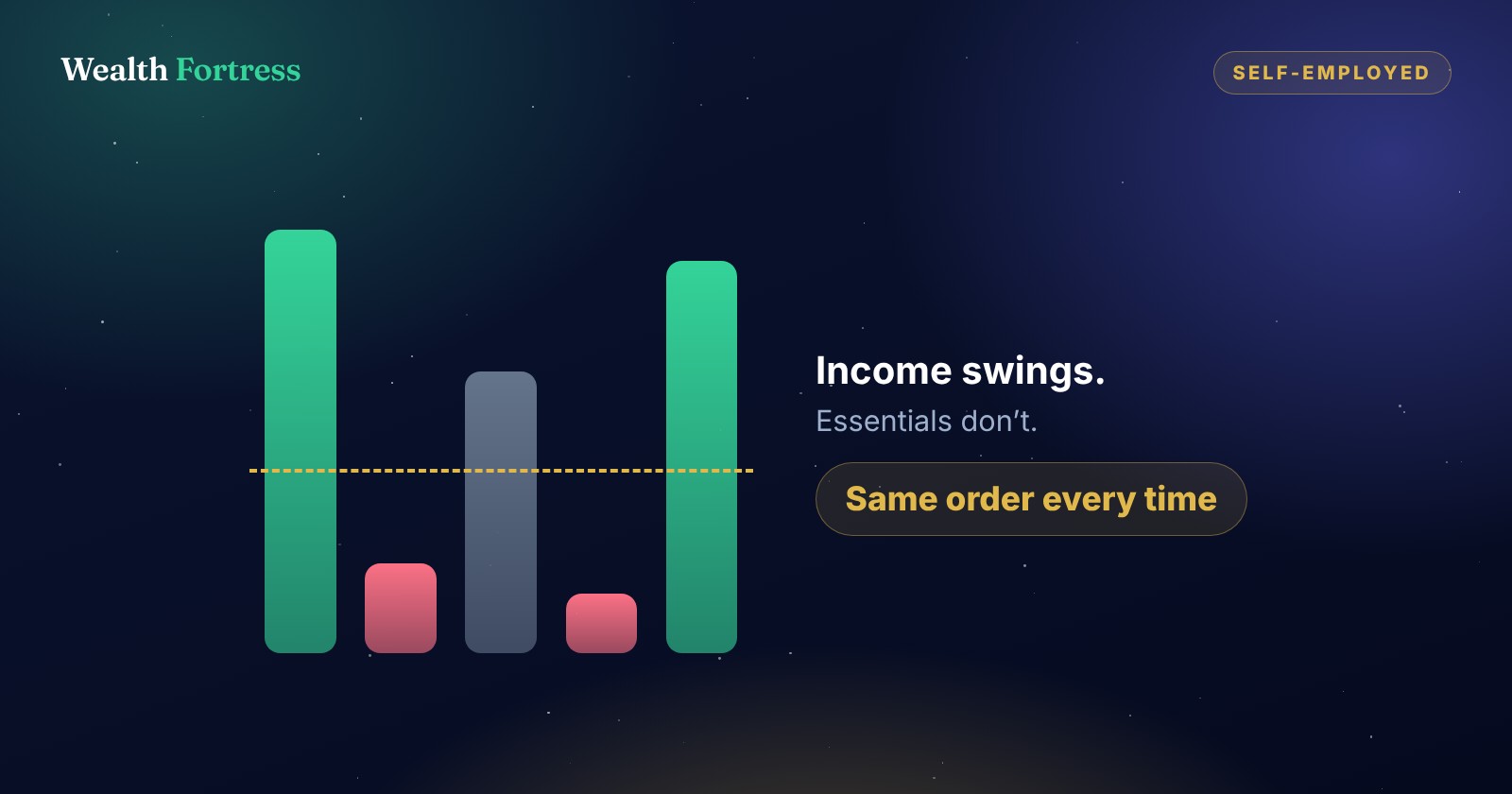
Decide, once, whose income is responsible for the fixed household costs, whoever is paid first.
This is exactly the gap we built into MoneyMap after a real household (ours, as it happens) ran into it directly — one partner paid monthly on a fixed date, the other in instalments that straddled two calendar months. Every income in MoneyMap can be marked as covering essentials or not, so the app always knows who's responsible for the mortgage regardless of payment order or timing. No renegotiating, no first-past-the-post.
Beyond the app: three things that make this genuinely easier
Name the split out loud, not just in your heads. "I cover the mortgage and bills, you cover food and the car" is a real agreement. "We just kind of sort it out" isn't, and it's usually where resentment starts.
If incomes are uneven, consider a proportional split rather than a 50/50 one. Covering costs in proportion to what each of you actually brings in often feels fairer than an even split when the gap between incomes is large.
Review it after a real income change, not just once at the start. A new job, a rate rise, a slow self-employed month — any of these is worth a five-minute conversation about whether the original split still makes sense.
If you're not sure what a fair split even looks like
Our free Golden Percentages tool walks through a handful of honest questions about your situation — including whether you're budgeting solo or as a couple — and builds a personalised starting split in about two minutes. No signup needed, and it's a genuinely useful starting point for the conversation above.
Build your starting split
Answer a few honest questions and get a personal split of your monthly money in about two minutes. No signup.
Try Golden Percentages